Arabic Roots in the Qur’an: Learn Vocabulary by Root
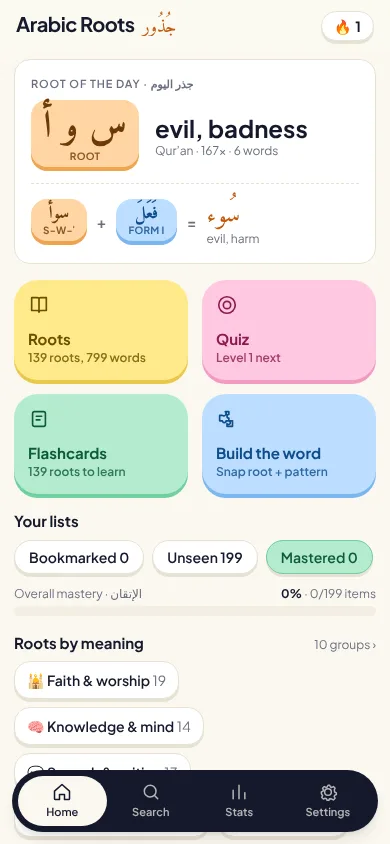
Learn one root, unlock a whole family of words. 139 Quranic roots and 799 words, with flashcards, quizzes and a build-the-word game.
In the app: root of the day · flashcards · levelled quizzes · build the word
For learners who can read Arabic script and want Qur’an vocabulary to stick.
- 139core roots
- 799Quranic words
- 10meaning groups
How Arabic roots work
Three consonants hold a core idea: writing.
A template that adds vowels and letters: the doer.
Root + pattern = writer. Learn the link once, reuse it everywhere.
Try it: see the root inside every word
Pick a root. The same three letters stay put while the pattern around them changes the meaning.
Writing
Knowledge
Mercy; womb
Forgiving, covering
Build the word
The app’s signature game, in miniature. Choose a root, then a pattern, and see the word they make.
Frequently asked questions
What are Arabic roots?
Most Arabic words are built from a root of usually three consonants that carries a core meaning. Patterns (called awzan) add vowels and extra letters around the root to make nouns, verbs and participles. For example, the root ك ت ب (k-t-b) carries the idea of writing and gives words such as كِتَاب (book) and كَاتِب (writer).
Do I need to learn roots to understand Quranic Arabic?
No, but it helps. Recognising a root lets you guess the meaning of unfamiliar words and see why related words belong together, which makes vocabulary easier to remember. It complements, and does not replace, learning grammar and reading with a qualified teacher.
Which roots should I learn first?
Start with the most frequent roots in the Qur’an, since you meet them constantly. The app ranks 139 roots by how often they occur; the top ten begin with أ ل ه (divinity, God, worship), ق و ل (saying) and ك و ن (being).
What is a wazn (pattern)?
A wazn is a template, traditionally written with the root ف ع ل, that shows how a word is formed from a root. فَاعِل, for instance, usually gives the doer (كَاتِب, writer), while مَفْعُول gives the thing done (مَكْتُوب, written). The Arabic Roots app lists the patterns in use with examples.
Is this for Quranic Arabic only?
The roots in the app are chosen by how often they occur in the Qur’an, so it is built for Quranic vocabulary. Arabic uses the same root-and-pattern system throughout, and many of these roots are common in modern Arabic too, so what you learn carries over.
How does the Arabic Roots app work?
It gives you a root of the day, flashcards, a quiz with levels, and a build-the-word game where you combine a root with a pattern. It also groups roots by meaning, lists patterns and affixes, and tracks your mastery.
Start learning Arabic roots
Flashcards, quizzes and a build-the-word game, ready in your browser.
Also from QariAI: recitation coach with Tajweed feedback on Google Play
Keep going: Qur’an games (Wasl, Qur’an Connect) · Tajweed for beginners · Tajweed rules